Political Parties in Western Democracies by Leon D. Epstein
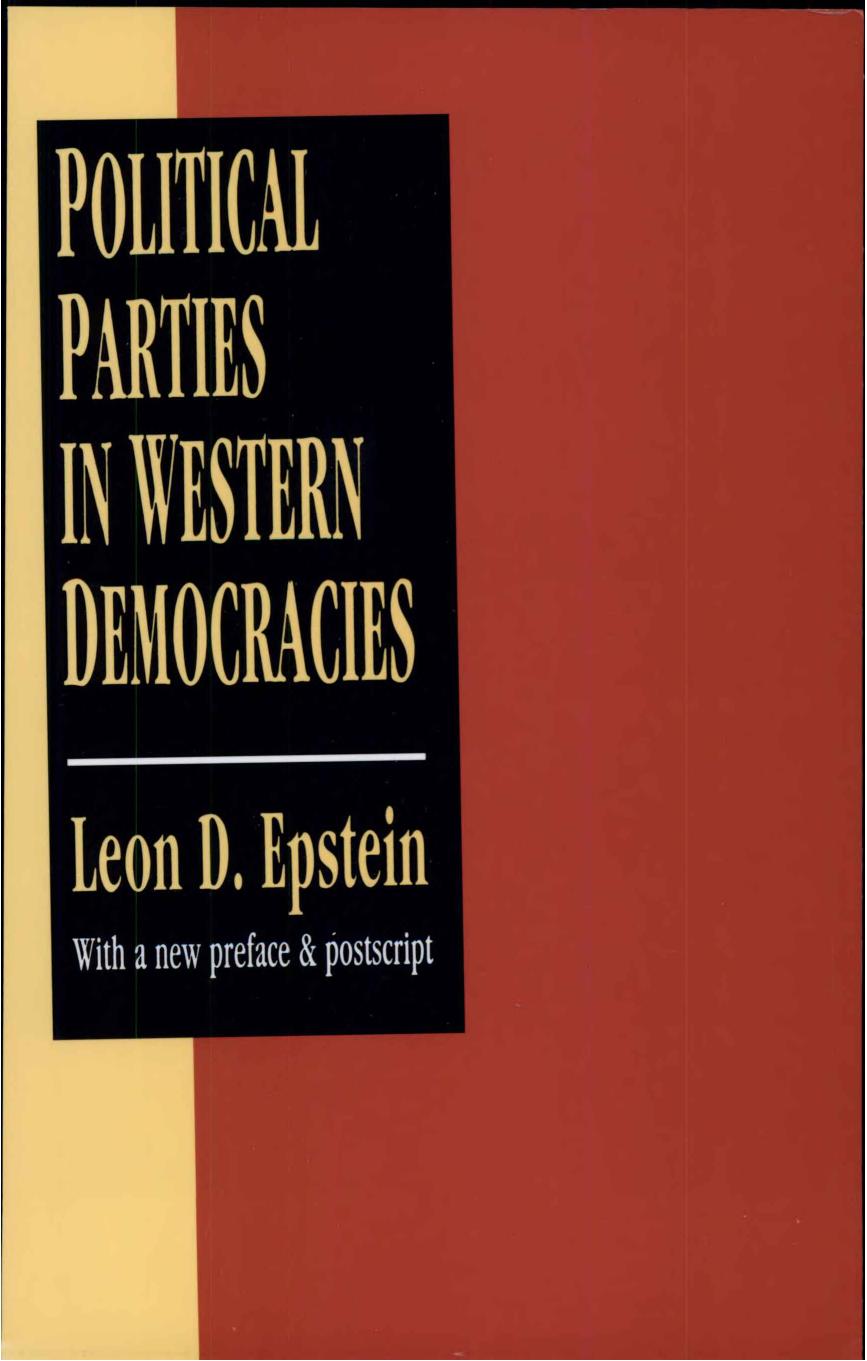
Author:Leon D. Epstein
Language: eng
Format: epub, pdf
Publisher: Transaction Books
61 Donald R. Matthews, U. S. Senators and Their World (Chapel Hill: University of North Carolina Press, 1960), p. 20.
Leaning backward, away from the argument, it is worth while to look at the membership of American national party committees, where the work is less time-consuming than in Congress and where working-class leaders could function without leaving their union positions. Of course, the total membership is even smaller than Congress's since each national committee has usually had only two members from each state, one man and one woman, although the Republicans have added a state chairman in certain cases. In studying the backgrounds of those serving between 1948 and 1963, only one labor leader (a Democrat) was found on a national committee. No one occupational^ classified as a worker was among either the 265 Democratic or 352 Republican committee members. Educationally also, there was little sign of an inter-party difference. Sixty per cent of the Democrats and 67 per cent of the Republicans had at least one college degree.62 No distinctively working-class leadership of a party is to be discerned at this level. Perhaps none should have been expected. But if it is not in the national committees, any more than in cabinets or in Congress, where is it to be found nationally?
If the answer, as it appears, is not to be found nationally at all, would it be worth while searching at the state level? Surely, one should approach a comparison of state legislatures to European parliamentary leadership with considerable skepticism. While American congressmen may be too high and mighty to be compared with European parliamentary deputies, American state legislators do not seem high and mighty enough. Their districts are usually small, their turnover high, the legislative sessions often brief, and their general importance in the community ordinarily much less than that of national figures in any country. Furthermore, there is good reason to believe that American state legislatures have always contained many members of modest social origins and even of modest occupational status (farmers, however, more frequently than industrial workers). Now, however, the number of lawyers and other urban middle-class men seems to be increasing at the expense of farmers in particular. If, as is possible, the number of industrial workers or ex-workers has also increased, it is not so marked as to blur the general professionalizing trend. The available data, however, are not entirely clear. As of 1949, when all of the states were surveyed, it was found that less than 5 per cent of the legislators were listed as laborers or craftsmen. Farmers were 22 per cent of the whole group, but lawyers, merchants, and other middle-class occupations predominated.63 The laborers and craftsmen were more frequent in certain (but not all) industrial states than in the country as a whole. It is also known, from other studies, that these manual workers are usually Democrats.
Download
Political Parties in Western Democracies by Leon D. Epstein.pdf
This site does not store any files on its server. We only index and link to content provided by other sites. Please contact the content providers to delete copyright contents if any and email us, we'll remove relevant links or contents immediately.
| Anthropology | Archaeology |
| Philosophy | Politics & Government |
| Social Sciences | Sociology |
| Women's Studies |
The Secret History by Donna Tartt(19092)
The Social Justice Warrior Handbook by Lisa De Pasquale(12190)
Thirteen Reasons Why by Jay Asher(8912)
This Is How You Lose Her by Junot Diaz(6887)
Weapons of Math Destruction by Cathy O'Neil(6281)
Zero to One by Peter Thiel(5802)
Beartown by Fredrik Backman(5755)
The Myth of the Strong Leader by Archie Brown(5508)
The Fire Next Time by James Baldwin(5447)
How Democracies Die by Steven Levitsky & Daniel Ziblatt(5219)
Promise Me, Dad by Joe Biden(5154)
Stone's Rules by Roger Stone(5088)
A Higher Loyalty: Truth, Lies, and Leadership by James Comey(4964)
100 Deadly Skills by Clint Emerson(4926)
Rise and Kill First by Ronen Bergman(4790)
Secrecy World by Jake Bernstein(4753)
The David Icke Guide to the Global Conspiracy (and how to end it) by David Icke(4720)
The Farm by Tom Rob Smith(4514)
The Doomsday Machine by Daniel Ellsberg(4490)
